

002 — Why Some Homes Feel Better Than Others: Understanding Quality in Residential Architecture
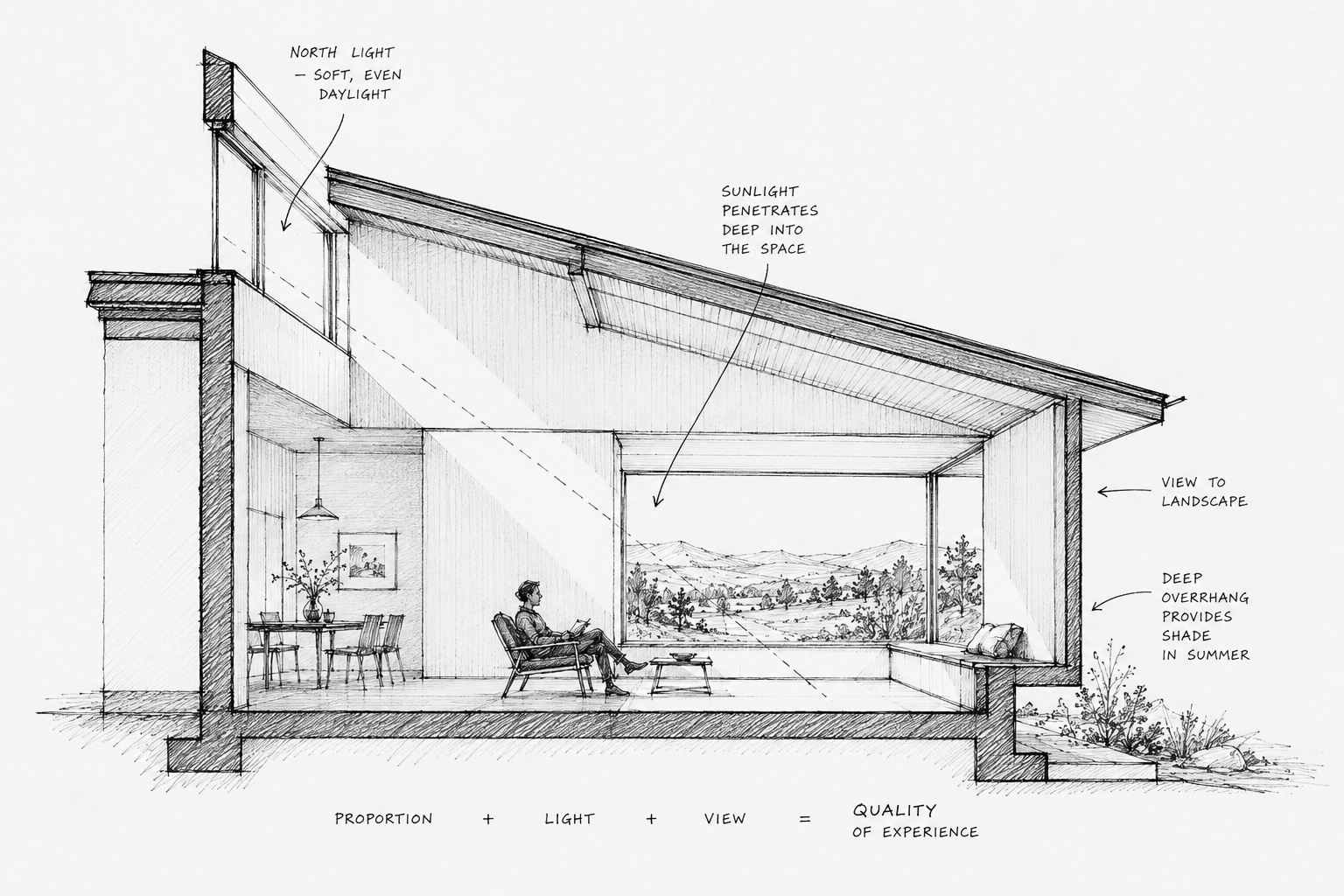
The measure of a home is not what it is made of, but how well it supports the people who inhabit it.
Most homeowners recognize quality when they experience it.
Some homes feel comfortable, intuitive, and enduring. They seem naturally suited to their occupants and surroundings. Others may be larger, newer, or more expensive, yet never feel quite right. The difference is rarely explained by materials alone. More often, it originates earlier, in the decisions that shaped the home before construction began.
Quality begins with design, and design begins with an understanding of how people will live.
This may seem counterintuitive. When people think about quality, they often think about visible things: stone countertops, custom cabinetry, premium appliances, or finely crafted trim. These elements contribute to a home’s character and durability, but do not by themselves create quality. A home may contain every luxury finish and still feel awkward, confusing, or disconnected. Conversely, a modest home can feel generous, comfortable, and enduring when thoughtful design guides its creation.
In residential architecture, quality of outcome has two inseparable dimensions: architectural quality and construction quality. Architectural quality concerns the design of the home—its spaces, proportions, light, organization, and relationship to its surroundings. Construction quality concerns how the design is realized through materials, assemblies, workmanship, and execution.
These two forms of quality work together, but are not interchangeable. Architectural quality defines what is built. Construction quality defines how well it is built. Both are necessary, but neither can fully compensate for the absence of the other.
Architecture begins with decisions about how people will live. Before materials are selected or construction documents prepared, the architect considers how spaces relate to one another, how daylight enters a room, how a family moves through the home, and how the building responds to its site. These decisions are rarely visible once construction is complete, yet they profoundly influence the experience of living in a home. They establish the framework within which all subsequent decisions occur.
The experience of a home is shaped by countless factors rarely noticed individually but deeply felt collectively. The height of a ceiling, window placement, sequence of spaces, relationship between interior and exterior, and quality of natural light all influence how a home is experienced. Some spaces feel calm, others energetic. Some feel intuitive and effortless, others awkward or confusing. These qualities are not accidental. They result from deliberate design decisions made long before construction begins.
A home’s relationship to its surroundings is equally important.
Every site has its own character. Topography, climate, vegetation, views, neighboring buildings, and daily life patterns all contribute to a place’s identity. Thoughtful residential architecture responds to these conditions rather than ignoring them. The orientation of a home influences daylight and energy performance. Window placement affects views, privacy, and comfort. The relationship between building and landscape shapes how the home is experienced through the seasons.
When a home responds thoughtfully to its environment, it feels connected to its place. When it does not, it often feels detached or imposed. Architectural quality therefore extends beyond the building itself. It includes the relationship between the home, its occupants, and the world around it.
Yet even the most thoughtful design remains only an idea until it is built.
This is where construction quality becomes essential.
Construction quality concerns transforming architectural intent into physical reality. It is revealed through workmanship, coordination of trades, performance of building systems, and durability of materials and assemblies over time. Good construction allows a design to be realized faithfully. Poor construction can undermine even the most carefully considered architectural work.
Construction quality cannot replace architectural quality. A beautifully executed design that is poorly conceived remains poorly conceived. Construction brings architecture into existence, but does not determine the quality of the architectural idea.
The highest-quality outcomes occur when architectural and construction quality work together. Design establishes the vision, priorities, and framework. Construction transforms those intentions into reality. Neither discipline is more important than the other. A thoughtful design deserves competent execution, and competent construction deserves thoughtful design.
This relationship helps explain why residential projects can produce vastly different outcomes even when budgets are similar. The difference is often not the money invested but how and when decisions are made.
Quality is frequently confused with cost.
I do not believe the two are synonymous.
Some of the most satisfying homes are not the largest, most elaborate, or most expensive. They are simply thoughtful. Their spaces feel appropriate. Their relationship to the site feels natural. Their materials are used with purpose. Their design reflects clarity rather than confusion and excess.
Quality is not reserved for luxury projects.
It can be pursued at virtually any scale and within virtually any budget.
The degree to which quality is realized depends on the level of architectural involvement throughout the project. Some projects require only limited architectural services and permit documentation. Others benefit from extensive design development, detailed construction documentation, and continued involvement throughout construction. As architectural involvement increases, more decisions are resolved before construction begins, reducing uncertainty and improving consistency throughout the process.
There is no universally correct level of architectural involvement. Different projects have different goals, priorities, budgets, and constraints. What matters most is that expectations, services, documentation, and responsibilities stay aligned. Many disappointments in residential construction occur not because of poor design or construction, but because expectations exceed the level of resolution provided.
A homeowner may expect a highly customized outcome while relying on limited documentation. A contractor may be asked to resolve design questions never fully addressed during the design phase. A project may rely on permit drawings while expecting the refinement typically found in a comprehensive set of construction documents. These situations are common and understandable, but often lead to frustration because important decisions are made later than they should or not at all.
The architect’s role is to help homeowners navigate these choices.
Architects do more than prepare drawings. They help homeowners evaluate possibilities, establish priorities, understand trade-offs, and make informed decisions throughout the life of a project. Architects shape the spatial, environmental, and experiential qualities of a home while coordinating the technical requirements necessary to realize those ideas. In this way, architectural services are not merely a collection of documents; they are the mechanism through which architectural quality is developed, communicated, and protected.
Ultimately, the quality of a home is not measured by its cost, size, or the prestige of its materials.
It is measured by how well it supports its occupants.
The most successful homes feel comfortable, coherent, and enduring. They support daily life with clarity and grace, respond thoughtfully to their surroundings, and age well. Such homes remain satisfying to inhabit not only when they are new, but also years and decades later.
This is the measure of quality.
And that is why some homes feel better than others.
Questions, thoughts, and discussion are always welcome.