

003 — The Role of the Architect: Understanding Residential Architectural Services
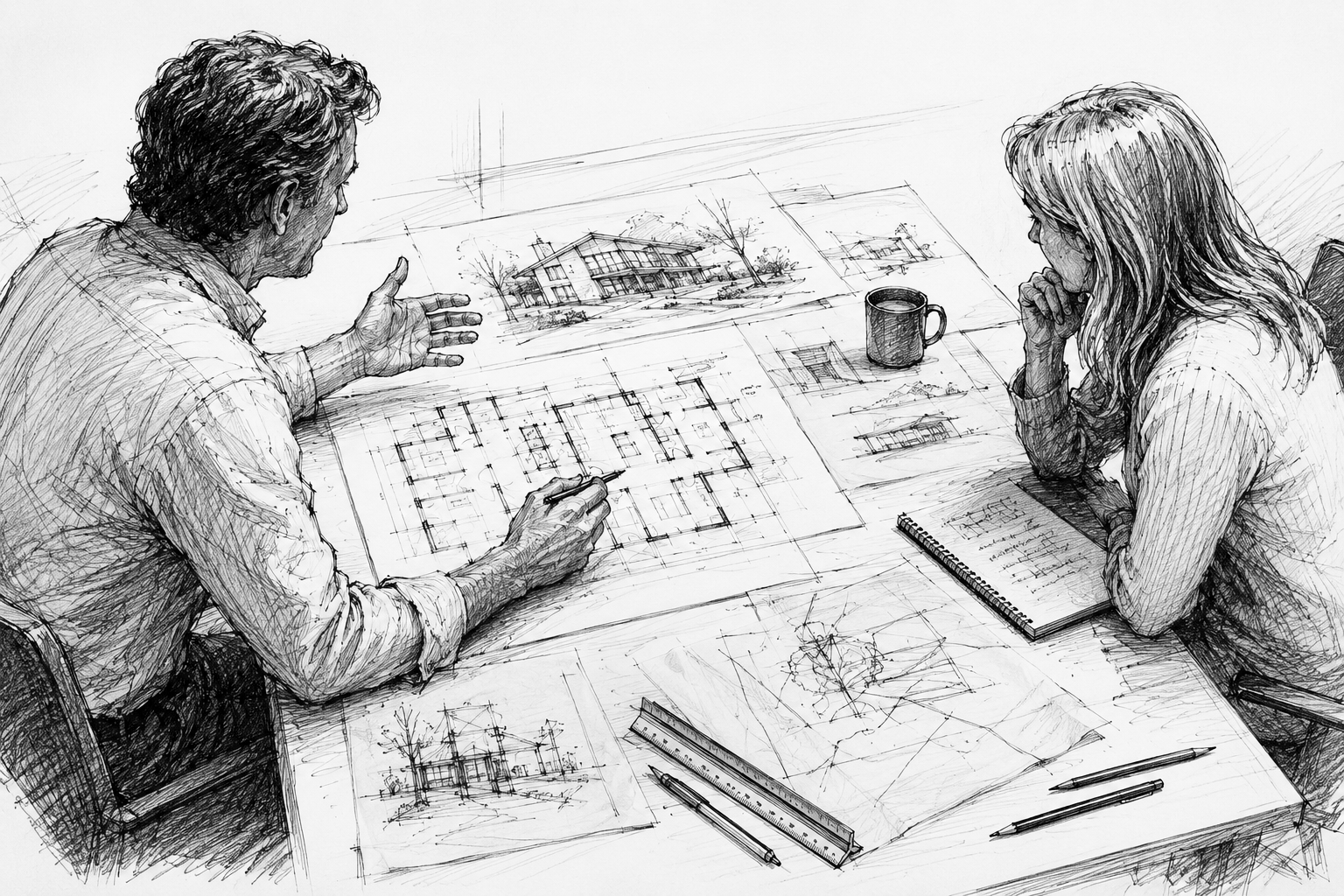
Architecture is the process of transforming ideas, priorities, and aspirations into built form.
Most homeowners understand that architects design buildings.
Fewer understand that an architect’s most important work often occurs long before construction begins.
While a contractor’s work becomes visible once construction starts, much of the architect’s contribution takes place beforehand. Architects listen, ask questions, evaluate opportunities and constraints, explore possibilities, develop ideas, coordinate information, and guide hundreds of decisions that collectively shape a project's outcome.
Architecture is therefore not a product that can be purchased. It is a professional service delivered over time.
The architect’s role is to help transform a homeowner’s goals, priorities, and aspirations into a coherent and buildable reality.
Every project begins with a conversation.
Some homeowners arrive with a clear vision. Others arrive with questions, uncertainties, or competing priorities. In either case, the architect’s first responsibility is to understand how the homeowner wants to live, what the project must accomplish, and what opportunities or constraints may influence the outcome.
This process extends far beyond aesthetics. Site conditions, zoning regulations, building codes, budget considerations, existing conditions, construction methods, and long-term performance all influence design decisions. The architect’s responsibility is to consider these factors together while maintaining a clear and consistent design direction.
For this reason, architectural services encompass much more than the preparation of drawings.
Drawings are essential, but they are ultimately the result of a much larger process involving observation, analysis, judgment, coordination, and decision-making. They communicate decisions that have already been considered, evaluated, and refined. The drawings themselves are not the service. They are one of its outcomes.
The relationship between homeowner and architect is therefore inherently collaborative. Homeowners contribute goals, priorities, preferences, and feedback. Architects contribute professional expertise, design judgment, technical knowledge, and experience. Successful projects emerge when these contributions work together.
As a project develops, decisions gradually evolve from broad questions to increasingly specific ones. Early discussions often focus on fundamental issues: What should be built? Where should it be located? Is the project feasible? How might the home relate to the site?
As the design develops, attention shifts toward space, proportion, light, materials, building systems, and construction. Decisions that initially appear independent often become interconnected. A change to one aspect of the design may influence many others.
This is why residential projects are typically organized into phases.
Early phases focus on understanding goals, exploring alternatives, and identifying constraints. Subsequent phases refine decisions, coordinate requirements, and gradually transform ideas into information that can be reviewed, permitted, priced, and ultimately built.
Although every project is unique, most follow a similar progression.
The process generally begins with exploration and feasibility, where opportunities and constraints are evaluated before major commitments are made. It then moves into design, where the project's overall direction is established and refined. Documentation follows, translating design intent into drawings and information suitable for permitting and construction. Finally, when included, the architect may remain involved during construction to help interpret the documents and support the realization of the design.
Not every project requires the same degree of architectural involvement.
Some projects benefit primarily from early planning and feasibility studies. Others require permit documentation to obtain regulatory approvals. More complex projects often benefit from continued architectural involvement through design development, construction documentation, and construction administration.
The appropriate level of service depends upon the goals, complexity, budget, and expectations of the project.
The primary difference between these levels of engagement is not design quality. Rather, it is the extent to which decisions are explored, developed, documented, coordinated, and maintained throughout the project.
As architectural involvement increases, more decisions are resolved before construction begins. This generally results in greater clarity, fewer assumptions, and reduced reliance on interpretation in the field.
This does not mean every project requires maximum architectural involvement. Different projects have different priorities. What matters most is that expectations remain aligned with the level of service being provided.
Many frustrations in residential construction arise not from poor design or construction, but from expectations exceeding the level of resolution established during design.
A homeowner may expect a highly customized outcome while relying on limited documentation. A contractor may be asked to resolve design questions that were never fully addressed during the design phase. Permit drawings may be expected to serve as comprehensive construction documents.
These situations are common and understandable. They are also one of the reasons architects place such emphasis on communication, coordination, and decision-making throughout the process.
Residential projects frequently involve other professionals as well. Structural engineers, surveyors, civil engineers, mechanical consultants, energy consultants, and other specialists may participate depending on the nature of the project. When consultants are involved, the architect typically serves as the primary coordinator, helping integrate their contributions into a coherent architectural solution.
Construction represents another important transition.
It is during construction that ideas become physical reality. Questions arise. Conditions are discovered. Adjustments become necessary.
When construction administration is included within the architect’s scope of services, the architect remains involved to help interpret the documents, respond to questions, and observe the work for general conformance with the design intent.
This involvement should not be confused with construction supervision. The contractor remains responsible for construction means, methods, sequencing, safety, and execution. The architect’s role is different. It is to help maintain continuity between what was designed and what is ultimately built.
Throughout this process, change remains a normal part of architectural work.
Early decisions are often exploratory and relatively easy to modify. As the project advances, decisions become increasingly interconnected and more difficult to change without affecting cost, schedule, or coordination. One of the architect’s responsibilities is to help homeowners understand these relationships so that decisions can be made thoughtfully and at the appropriate time.
Ultimately, architectural services exist to support informed decision-making.
They provide a framework for exploring possibilities, understanding trade-offs, coordinating complexity, and transforming ideas into built form.
The architect’s role is not simply to draw a building. It is to help homeowners make thoughtful decisions about the places they inhabit. That is the purpose of architectural services.
And that is the value architects provide.
Questions, thoughts, and discussion are always welcome.